I had been hearing about XPA prior to 13 May 2026. But on that fateful day, at Lecture Theatre F208, I came across their leadership figures.
Sonta Computer Society (SCS) had organised a panel discussion titled: “Future of work: Generative AI and the evolving media production industry”. There was much talk on the capabilities of AI: AI in film-making, AI in advertising.
Then I bumped into K at the refreshment station (pasta and sugary drinks), and K said: “Are you a member of XPA? It is very difficult to help freelancers if you are not part of XPA. Usually, when ministers want to have a discussion with freelancers, they will do so with a collective body, not with individuals.”
K added, “And on the practical side, with the XPA membership, you can get X-Points to subsidise your supermarket purchases.”
I replied: “I've been thinking about it for a while now. I will consider it seriously. It's too tiring to go alone.”
That was the beginning of my adventure into XPA Land. A few events that have happened on Planet XPA:
I've been attending their events since May 2025. They organise many events but primarily I attend the ones titled Actors' Kopitiam.
30 May 2025
Heard from a film director about how he struggled to work around background extras who make themselves conspicuous on camera – such as wearing shocking pink – when he wants them to be unobtrusive, perhaps through an all-black attire.
28 July 2025
Heard from a action director about how to work with directors who seem clueless about how to achieve stunts on camera (think: kungfu moves like Neo's, in The Matrix series). Sometimes they ask for stunts that human bodies are physically incapable of achieving -
This lunar cycle marks another point in the rhythm of the music of this vast planet. O wonder! This is the same moon that Beethoven looked at! What a thought!
In my brief mortal life, this cycle has seen a few conferences and gatherings, large and small in number of participants.
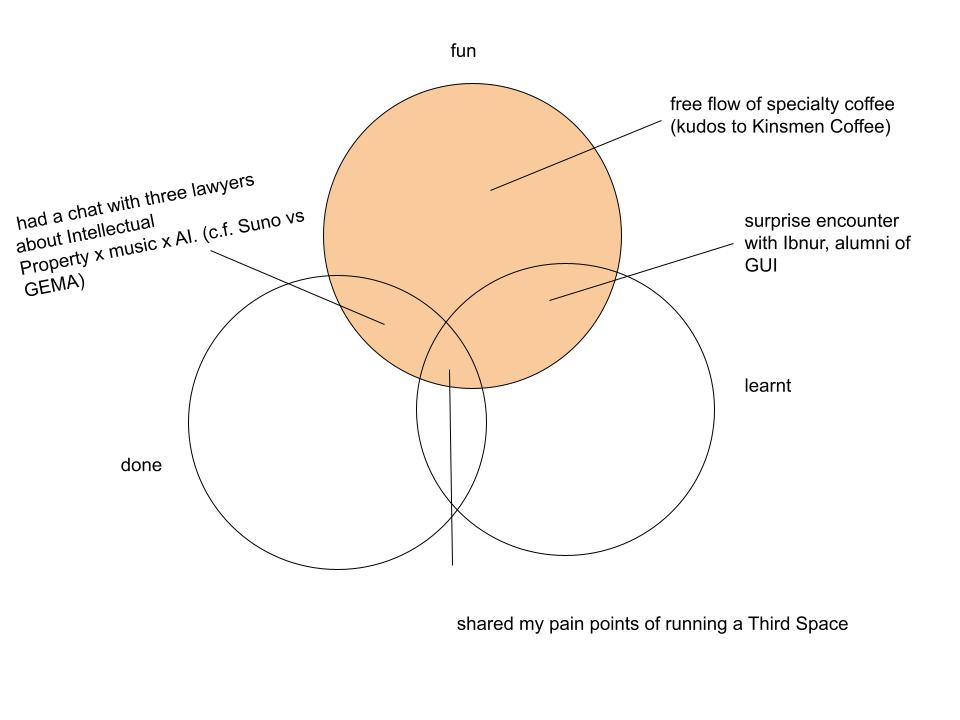
The below diagram shows my reflections after one such conference, organised by IPOS (Intellectual Property Office of Singapore). I categorised it into Fun, Done and Learnt.
Yesterday I caught a theatre show that featured practitioners of puppet theatre. It is a form that is practised in rural areas of Tokushima, Japan.
The reading material arrived in my inbox on a Wednesday, five days before the workshop was due to start.
It was from a 2016 book: “Applied Theatre: Facilitation
Pedagogies, Practices, Resilience”, by Sheila Preston. Chapter 1 presented a case study where:
a member of a mental health institution expressed his disquiet at the idea that other members of the group were happy to perform, in public, a play about the experience of mental illness. He felt uncomfortable with the association and that they would be representing “him”.
Indeed, any intervention – which may sometimes be a facilitated workshop, or a staged theatre production – may run the risk of reproducing dominant narratives, leading to anxiety and sensitivity among the disenfranchised.
What then is the role of a facilitator in this social and cultural system that surrounds the facilitator on all sides – whether at the family dinner table, or at the workplace desk, or during the morning commute?
Date: 21 August 2026, 8 PM.
Venue: Waterfront Theatre at Esplanade, Singapore
A howl emerged from the character on stage. “You're a bag of rats!”
The character had a pot belly, wore a beard, and sported a mass of curly, rust-brown hair – and when he got upon his feet, after having lain down conspicuously, the audience could see, stretching around his corpulent belly, the waistband of his off-white underwear.
“My mental health is going from bad to worse!” he screamed.
The character was not in a monologue; for the large part of half an hour, he had been verbally jabbed, poked, and mocked by another character: buxom, blonde and lipstick-ed. And cruel.